

As AI moves from experimentation to production, most real-world knowledge still lives in unstructured documents, making document parsing a critical foundation for how large models access and act on that information. The ability to accurately extract structured data from massive volumes of these documents directly determines both the efficiency of AI training and the extent of its industrial deployment.
Last year, INF broke the long-standing "dilemma" between specialization and generalization with Infinity-Parser, the industry's first reinforcement-learning-based document parsing model. Yet real-world deployment poses two new challenges: a single model must master many heterogeneous parsing tasks at once, and it must do so under widely varying constraints of accuracy and latency.
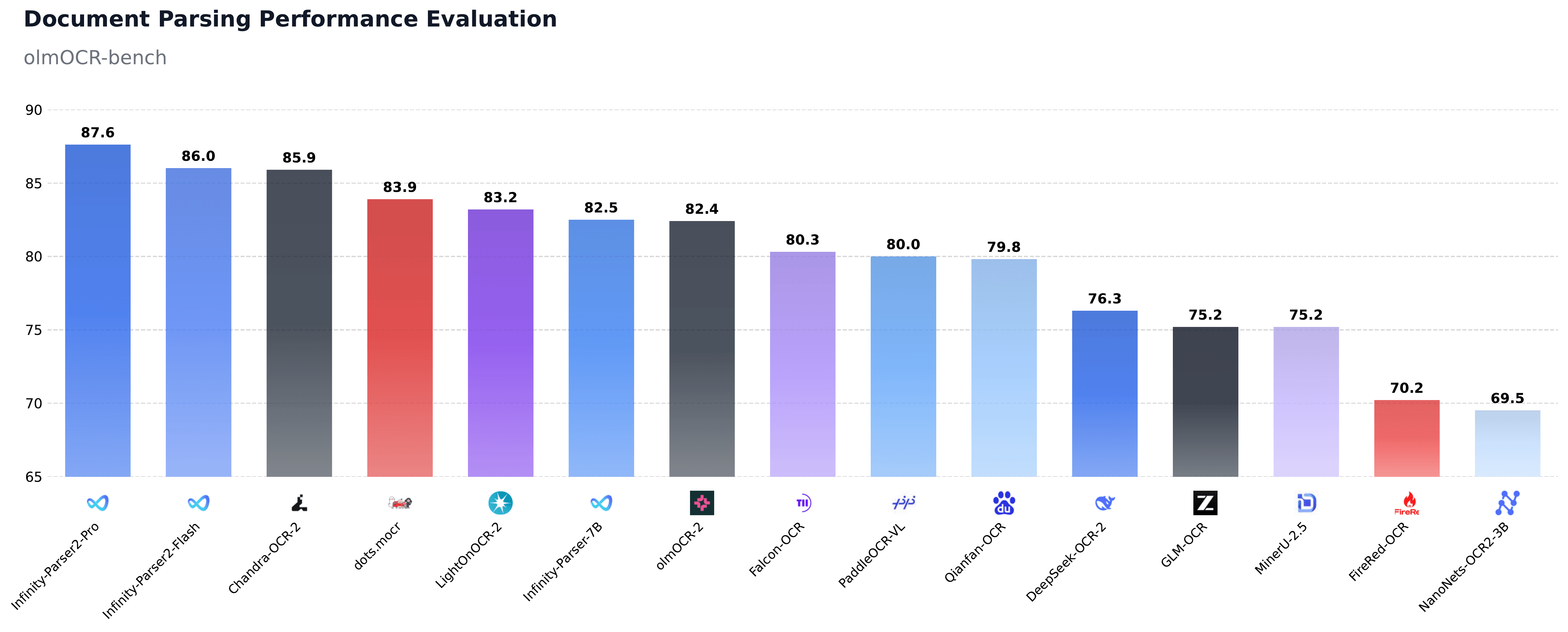
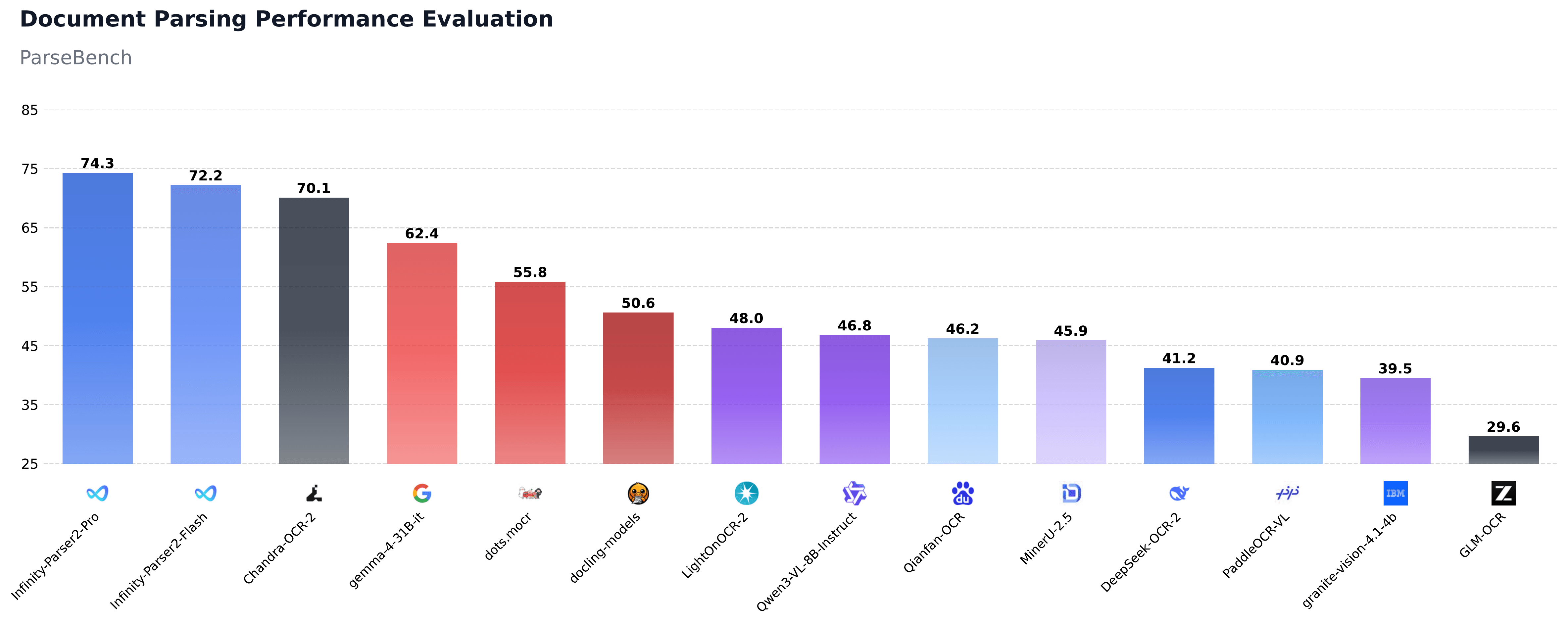
Recently, INF released Infinity-Parser2, its latest flagship document understanding model, offered in two variants tailored to diverse deployment needs. Infinity-Parser2-Pro, optimized for precision-critical scenarios, achieves state-of-the-art results on olmOCR-Bench (87.6%) and ParseBench (74.3%), surpassing frontier models including DeepSeek-OCR-2, PaddleOCR-VL-1.5, and MinerU-2.5. Infinity-Parser2-Flash, engineered for low-latency inference, delivers a 3.68x throughput speedup over the previous Infinity-Parser-7B. Powered by a comprehensively upgraded data engine and a novel multi-task reinforcement learning framework, Infinity-Parser2 consolidates robust multi-modal parsing into a unified architecture while unlocking brand-new zero-shot capabilities across a wide range of real-world business scenarios.
Accuracy Breakthrough: One Model, Many Tasks, "Like a Human"
The core challenge is moving large models beyond text recognition toward structural understanding, and from handling a single document type to mastering many at once. Traditional pipelines stitch together separate specialist models for tables, formulas, charts, and layout, which is costly to maintain and prone to error propagation.
Building on the multi-dimensional reward mechanism of the first generation, the INF team designed a novel verifiable reward system that supports Joint Reinforcement Learning, enabling seamless and simultaneous co-optimization of multiple complex tasks — document parsing, element parsing, chart parsing, chemical formula parsing, document VQA, and general multimodal understanding. As a result, Infinity-Parser2-Pro substantially outperforms the previous 7B model, reaching 87.6% on olmOCR-Bench and 74.3% on ParseBench. It also leads on element-level tasks such as table recognition (PubTabNet 94.76) and formula recognition (UniMERNet 97.7), more faithfully restoring complete document information the way a human reads — overall layout first, then specific content — and proving especially accurate and robust on complex pages with multi-column mixing, interleaved text and figures, and irregular tables.
Take finance as an example. Corporate disclosures are stored in PDFs dense with cross-laid charts and tables, demanding the highest parsing precision. Faced with financial reports containing complex frameless tables, traditional OCR models can recognize every character but cannot accurately understand "borderless table ranges, complex row-column structures, and reading order." Infinity-Parser2 correctly parses table boundaries, perceives row-column correspondence, and reconstructs reading order, more precisely restoring complete document information and better grasping both content and structure across multilingual international markets.
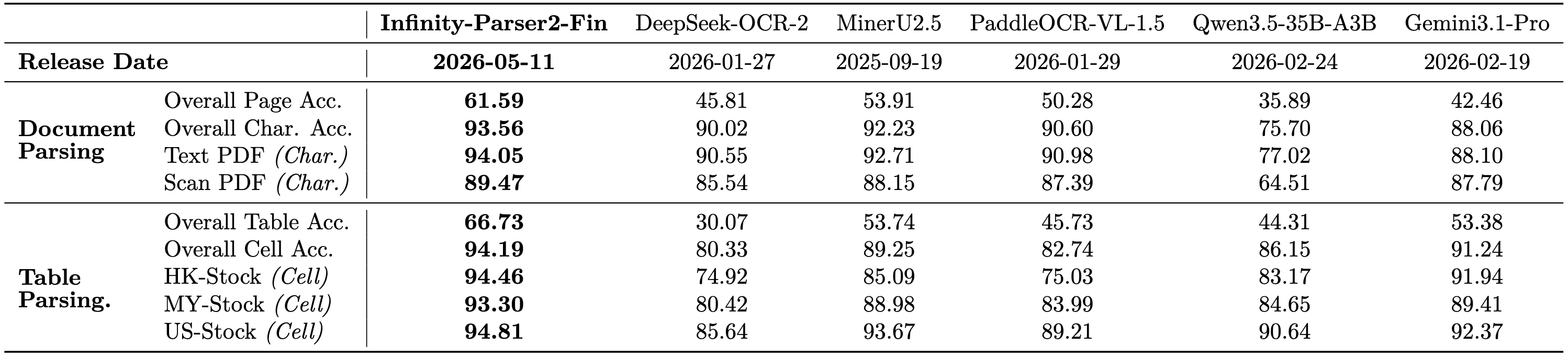
Note: Fine-tuned on our internal business training set, Infinity-Parser2-Fin excels at frameless tables and complex layouts in real-world financial scenarios and surpasses peer models by over 10pt in document and table parsing accuracy. Metrics are from INF's internal evaluation tools.
Data Flywheel: A Self-Reinforcing Engine That Targets Its Own Weak Spots
While raw documents are abundant, transforming them into high-quality, task-relevant training data under limited annotation and compute budgets remains a major challenge. Conventional static pipelines fix the dataset before training begins, so they cannot respond to a model's evolving weaknesses — over-investing in already-mastered patterns while under-covering the rare, difficult cases that matter most.
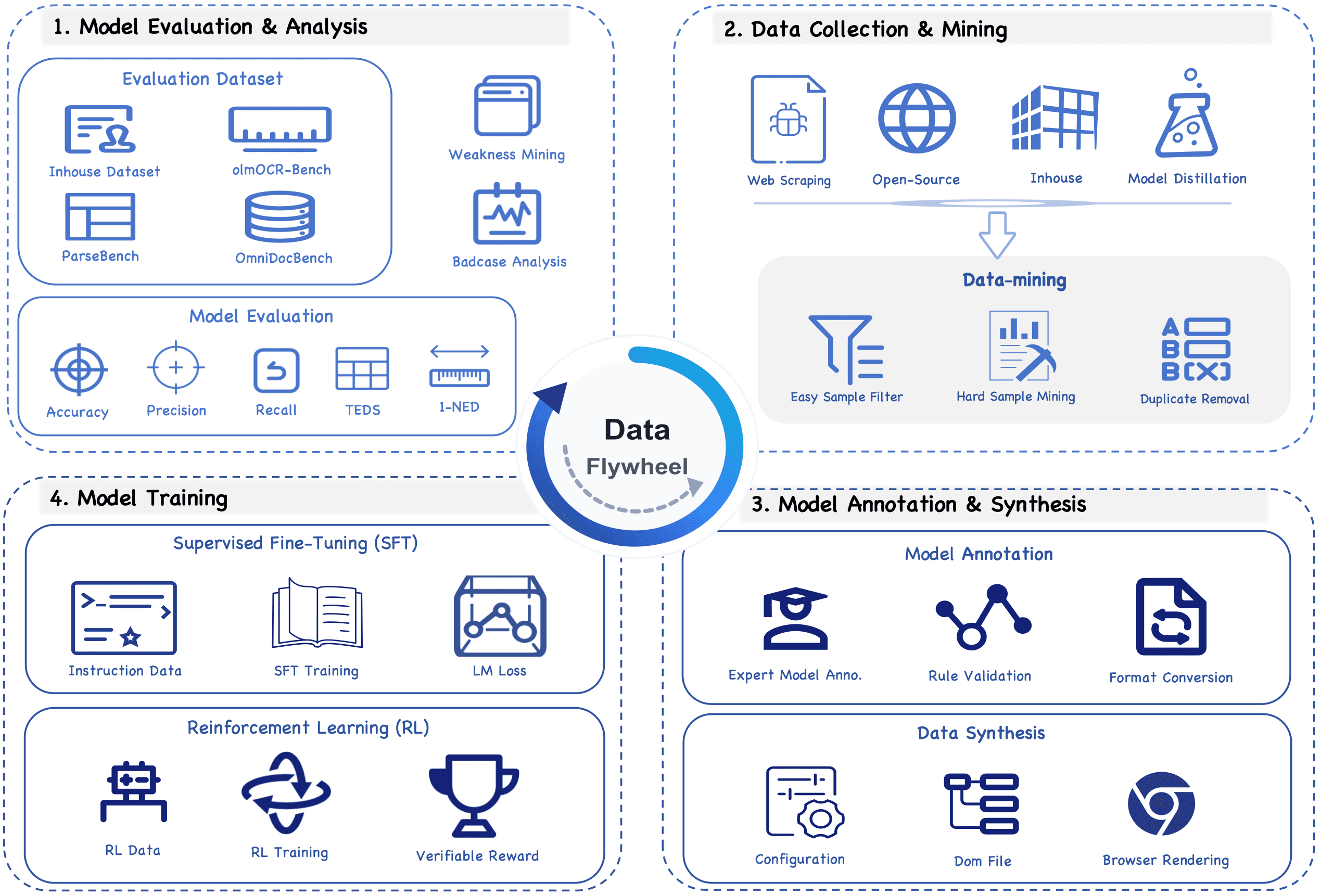
To break this bottleneck, the INF team built a self-developed, model-driven data flywheel — a closed loop in which evaluation, bad-case mining, data construction, and fine-tuning continuously reinforce one another. On each turn, the current model is evaluated across multi-task benchmarks and its failures are distilled into a weakness taxonomy spanning document type, element type, and layout pattern; targeted documents matching those weaknesses are mined from web, public, and proprietary sources, labeled by domain-expert models, and supplemented by INF's DOM-based synthesis engine, which renders rare layouts, low-resource languages, and under-represented elements with ground-truth labels at near-zero cost. The fine-tuned model then returns as the new baseline, so each iteration's residual weaknesses become the next round's targeted training data — ultimately yielding the balanced, roughly 5-million-sample Infinity-Doc2-5M dataset.
This self-reinforcing loop turns continuous improvement into a compounding advantage. Instead of re-collecting data from scratch for every new requirement, the flywheel automatically channels effort toward a model's true blind spots — frameless financial tables, multi-column reports, multilingual typesetting — keeping it sharp on long-tail document types at a fraction of the cost and making AI genuinely usable deep inside real business workflows.
Beyond Accuracy: Toward Practical, Deployable Parsing
Beyond accuracy, deployment efficiency determines whether a model is truly usable at scale. Infinity-Parser2-Flash raises inference throughput by 3.68x (from 441 to 1,624 tokens/sec), substantially reducing latency and deployment cost while retaining the vast majority of Pro's parsing quality — giving enterprises a flexible accuracy-versus-cost trade-off from a single model family.

Note: Infinity-Parser2 retains strong general multi-modal capability while specializing in document parsing.
Notably, although Infinity-Parser2 is optimized for document parsing, it fully preserves general multi-modal understanding and reasoning, scoring competitively on benchmarks such as MMMU (61.89) and DocVQA (96.43) and charting a new path around the "catastrophic forgetting" that commonly plagues task-specific SFT. To advance the document parsing field as a whole, the INF team has also open-sourced Infinity-Doc2-5M, a large-scale multimodal parsing dataset. Composed mainly of public and synthetic data with business-sensitive and privacy-related content removed, it extends an open and collaborative invitation for the wider community to push the boundaries of document parsing together.
About INF: Become the Trusted Intelligence of Choice for Mission-Critical Industries Worldwide
INF is a global AI-native technology company and an intelligent service partner for mission-critical industries worldwide. Built on a trustworthy GenAI technology system, INF focuses on finance, science, and education, developing AI infrastructure as well as industry-grade products and services that help enterprises improve efficiency, support decision-making, create measurable value, and earn long-term trust in real complex business environments.
Related Links:
- Open Weights (Pro): https://huggingface.co/infly/Infinity-Parser2-Pro
- Open Weights (Flash): https://huggingface.co/infly/Infinity-Parser2-Flash
- Open Dataset: https://huggingface.co/datasets/infly/Infinity-Doc2-5M
- Code: https://github.com/infly-ai/INF-MLLM
- Demo: https://huggingface.co/spaces/infly/Infinity-Parser2-Demo


